How late is normal
Very few people have a cycle that runs exactly the same length every month. The NHS describes regular cycles of anywhere from 21 to 35 days as normal, and it is common for your own cycle to shift by a few days, sometimes up to a week, from one month to the next.
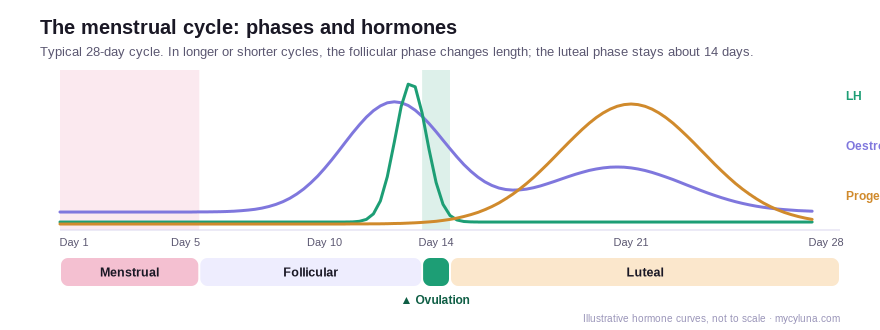
The key thing to understand is that the second half of your cycle (from ovulation to your period) is fairly steady at about 10 to 16 days. So when a period is late, it nearly always means ovulation happened later than usual, not that something is wrong with the period itself.
Key Takeaways
- Up to about 7 days late is often normal variation from a later ovulation.
- If pregnancy is possible, test from the day your period was due, using first-morning urine.
- The NHS advises seeing a GP if you have missed 3 periods in a row.
- Late period plus one-sided pain, shoulder-tip pain or fainting needs urgent care.
What each stage of lateness usually means
| How late | What it usually means | What to do |
|---|---|---|
| 1–4 days | Normal month-to-month variation | Test if pregnancy is possible |
| 5–7 days | Late. Pregnancy or a later ovulation are the usual reasons | Take a pregnancy test |
| 8–14 days | A negative test now is fairly reliable; ovulation was probably late | Retest in 3–5 days if still no period |
| 2–8 weeks | Possibly a skipped ovulation (stress, weight change, PCOS, thyroid, breastfeeding) | Retest; note any other symptoms |
| 3 missed periods | Needs checking even with negative tests | See a GP (NHS advice) |
You can see exactly how many days late you are, based on your own cycle length, with the late period calculator.
Why periods run late
The NHS lists the most common causes of missed or late periods as pregnancy, stress, sudden weight loss or gain, doing a lot of exercise, hormonal contraception, polycystic ovary syndrome (PCOS) and the start of the menopause. Other everyday reasons include illness, travel across time zones and changes to sleep.
All of these work in a similar way: they delay or block the hormone surge that triggers ovulation. Once ovulation does happen, the period usually follows about two weeks later. That is why a late period after a stressful month is so common.
For the full list and how long each typically delays a period, see how many days a period can be delayed.
When to take a pregnancy test
Most home pregnancy tests are reliable from the first day of a missed period. For the clearest result:
- Use first-morning urine, when the pregnancy hormone hCG is most concentrated.
- If the result is negative but your period still has not arrived, retest in 3 to 5 days.
- If you know when you ovulated, the pregnancy test calculator tells you the earliest day a test becomes reliable for your cycle.
Not sure where you stand?
Answer five quick questions and get a plan: likely reasons, when to test and when to see a doctor.
Take the Am I Late? quizWhen to see a doctor
Get urgent helpIf you have a positive pregnancy test together with pain on one side of your lower tummy, pain in the tip of your shoulder, dizziness or fainting, call 111 or seek urgent care. These can be signs of an ectopic pregnancy.
Book a routine GP appointment (NHS advice) if:
- you have missed 3 periods in a row and you are not pregnant;
- your periods have become irregular;
- you have missed a period and also have symptoms such as weight gain or loss, tiredness, hair growth on your face, or dry or oily skin, which can point to PCOS or a thyroid problem;
- your periods have not started by the time you are 15.
A GP can check for common causes, such as thyroid problems or PCOS, with a simple examination and blood tests.