Fertile Window Calculator: Your Fertile Days and Daily Chances

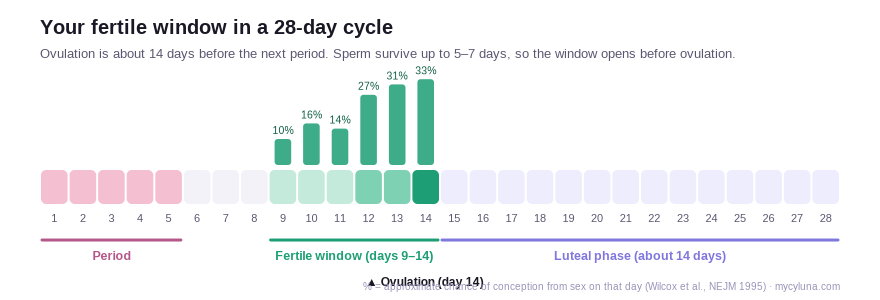
Quick answer: your fertile window is the 5 days before ovulation plus ovulation day. Ovulation is usually about 14 days before your next period, so in a 28-day cycle you are fertile on days 9–14, and most fertile on days 12–14. Enter your dates to see your own fertile days and the chance of conception on each one.

Evidence-based: built on NHS guidance and the Wilcox (NEJM 1995) conception study. Last updated: November 2026

Find My Fertile Days

Everything is calculated privately in your browser.

Count from day 1 of one period to the day before the next.

Your fertile window

Diagram of a 28-day cycle showing the fertile window on days 9 to 14 and the chance of conception rising from about 10% five days before ovulation to about 33% on ovulation day.
Chance of conception by day of the fertile window. Source: Wilcox et al., New England Journal of Medicine, 1995.

Ovulation day and fertile window by cycle length

Count from day 1 (the first day of your period). Ovulation is usually about 14 days before your next period, so it moves with your cycle length. The fertile window is the 5 days before ovulation plus ovulation day.

Cycle lengthLikely ovulation dayFertile windowMost fertile days
21 daysDay 7Days 2–7Days 5–7
22 daysDay 8Days 3–8Days 6–8
23 daysDay 9Days 4–9Days 7–9
24 daysDay 10Days 5–10Days 8–10
25 daysDay 11Days 6–11Days 9–11
26 daysDay 12Days 7–12Days 10–12
27 daysDay 13Days 8–13Days 11–13
28 daysDay 14Days 9–14Days 12–14
29 daysDay 15Days 10–15Days 13–15
30 daysDay 16Days 11–16Days 14–16
31 daysDay 17Days 12–17Days 15–17
32 daysDay 18Days 13–18Days 16–18
33 daysDay 19Days 14–19Days 17–19
34 daysDay 20Days 15–20Days 18–20
35 daysDay 21Days 16–21Days 19–21
36 daysDay 22Days 17–22Days 20–22
38 daysDay 24Days 19–24Days 22–24
40 daysDay 26Days 21–26Days 24–26
42 daysDay 28Days 23–28Days 26–28
45 daysDay 31Days 26–31Days 29–31

Estimates assume a 14-day luteal phase (the normal range is roughly 11–17 days). If you have irregular cycles, use the irregular period calculator or confirm with LH tests: see how the LH surge works.

What the fertile window is

You can only get pregnant on a handful of days each cycle. The NHS explains that sperm can survive for up to 7 days after sex, while the egg lives for about 12 to 24 hours once it has been released. Put together, that creates a window of roughly six days: the five days before ovulation, when sperm can already be waiting, and ovulation day itself.

The window ends abruptly. Once the egg has gone, sex later in that cycle cannot lead to pregnancy, which is why the day after ovulation carries almost no chance.

Your chance of conceiving on each fertile day

The clearest numbers come from a study of 221 women who measured their hormones daily to pinpoint ovulation (Wilcox et al., 1995). The approximate chance of pregnancy from sex on a single day was:

Day of sexChance of conception
5 days before ovulationabout 10%
4 days beforeabout 16%
3 days beforeabout 14%
2 days beforeabout 27%
1 day beforeabout 31%
Ovulation dayabout 33%

These figures come from couples without known fertility problems, and chances vary with age and health. The pattern is what matters: the last three days of the window are the most fertile.

How to find your fertile days more precisely

If your cycles vary, a single date can mislead you. The ovulation calculator has an irregular-cycle option that gives a fertile range instead.

Not a method of contraception

Because ovulation can move by several days from one cycle to the next, a calculator cannot tell you which days are safe for unprotected sex. If you want to avoid pregnancy, talk to a GP, nurse or sexual health clinic about contraception.

Frequently asked questions

A fertility calculator (also called a fertile window or fertile days calculator) estimates the days in your cycle when sex can lead to pregnancy. It works out your likely ovulation day from your last period and cycle length, then marks the 5 days before ovulation plus ovulation day.

About 6. Sperm can survive for several days, so sex in the 5 days before ovulation can still lead to pregnancy, and the egg lives for about 12 to 24 hours after it is released. After that, the chance of conceiving in that cycle drops close to zero.

The 2 days before ovulation and ovulation day. In the best-known study of conception timing (Wilcox et al., NEJM 1995), the chance of pregnancy from sex on each of those days was roughly 27 to 33%, compared with about 10% five days before ovulation.

No. Calendar estimates can be several days out because ovulation moves from cycle to cycle, so no date-based calculator is a reliable form of contraception. Speak to a GP, nurse or sexual health clinic about contraception.

It is a good starting estimate if your cycles are regular. A BMJ study of 221 women found the fertile window often fell outside the days calendars assume, even in regular cycles. Combine the estimate with ovulation (LH) tests or cervical mucus checks for a much clearer picture.

Use the irregular option in our ovulation calculator, which gives a fertile range from your shortest and longest cycles, and start LH tests a few days before the earliest possible fertile day.

Sources: NHS: Periods and fertility in the menstrual cycle; Wilcox et al., NEJM 1995; Wilcox et al., BMJ 2000. Estimates only, not medical advice or contraception.