The short answer
You cannot choose your baby’s sex with an ovulation calculator, an app or a timing plan. It is a lovely thing to wonder about, and the internet is full of “boy or girl” calculators, but when the timing idea was tested against carefully measured ovulation dates, it made no difference.
What timing does change is whether you get pregnant at all. So the most useful thing an ovulation calculator can do is show you your fertile window, and you can find yours with the Cyluna ovulation calculator.
Key Takeaways
- The Shettles method links sex near ovulation with boys and earlier sex with girls.
- A large study that measured ovulation with daily hormone tests found no effect of timing on the baby's sex.
- Timing strongly affects your chance of conception: the best days are the 2 days before ovulation and ovulation day.
- The only reliable way to select sex is IVF with embryo testing, which is restricted to medical reasons in the UK.
What the Shettles method claims
The idea dates back to the 1970s. It rests on a belief that sperm carrying a Y chromosome (which would make a boy) swim faster but die sooner, while X-carrying sperm (a girl) are slower but hardier. From that, the method suggests:
- For a boy: have sex as close to ovulation as possible, so the faster Y sperm reach the egg first.
- For a girl: have sex 2 to 3 days before ovulation and then stop, so only the longer-lived X sperm are still around when the egg is released.
Most online “boy or girl ovulation calculators” simply take your ovulation date and label the days before it “girl days” and ovulation day “boy day”. That is all they are doing.
What the research found
The best test of the timing theory comes from a study published in the New England Journal of Medicine in 1995. Researchers followed 221 women trying to conceive, recorded every act of intercourse, and measured hormones in daily urine samples to pin down the day of ovulation far more precisely than a calendar can.
When they looked at the pregnancies that resulted, the sex of the baby was not related to when intercourse happened relative to ovulation. Couples who had sex on ovulation day were no more likely to have a boy than couples whose last sex was several days before.
That fits what lab studies have found about sperm. Comparisons of X-bearing and Y-bearing sperm have not shown the large differences in speed and survival that the Shettles method depends on.
Why the theory sounds convincing
If the method does not work, why do so many people say it worked for them? A few honest reasons:
- It works half the time by chance. Roughly 51 out of 100 babies are boys. Any method “succeeds” about half the time, and people who got the sex they hoped for are more likely to share their story.
- Older studies were small and used rough ovulation estimates. Basal body temperature and calendar counting can be off by several days, which makes any timing result unreliable.
- It feels logical. The fast-boy, slow-girl story is easy to picture, which makes it memorable even without evidence.
What timing does change
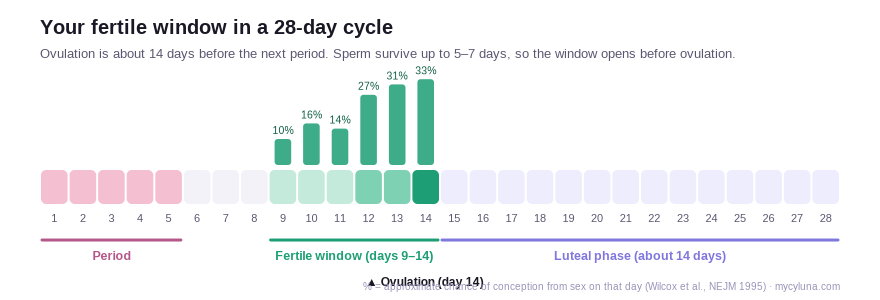
Timing is still the single most useful thing to get right when you are trying to conceive, just not for choosing sex. In the same 1995 study, pregnancy only happened when sex took place in a 6-day window ending on ovulation day, and the chance per day rose steeply towards ovulation:
| Day of sex | Approximate chance of conception |
|---|---|
| 5 days before ovulation | about 10% |
| 4 days before | about 16% |
| 3 days before | about 14% |
| 2 days before | about 27% |
| 1 day before | about 31% |
| Ovulation day | about 33% |
| Day after ovulation | very low |
Aiming sex at only the “girl days” 2 to 3 days early, or holding off until a single “boy day”, can therefore lower your chance of getting pregnant that cycle without changing the outcome you were hoping for. If tracking feels stressful, there is a simpler route: because sperm can survive for up to 7 days (NHS), having sex every 2 to 3 days throughout the cycle covers the fertile window without needing to know the exact day.
Find your real fertile window
Enter your last period and cycle length to see your ovulation day and the 6 days when pregnancy is possible.
Ovulation CalculatorMethods that do select sex
The only reliable method is IVF with preimplantation genetic testing (PGT), where embryos are tested before transfer. In the UK, the HFEA does not allow choosing an embryo’s sex for social reasons; it is only permitted to avoid a serious inherited condition that affects one sex. Sperm-sorting techniques are not licensed for sex selection in the UK either.
If you find yourself feeling strongly about having a boy or a girl, that is a very common and human feeling. Many parents find it helps to talk it through with a partner, a friend or a counsellor before or during pregnancy.
Sources
- Wilcox AJ, Weinberg CR, Baird DD. Timing of sexual intercourse in relation to ovulation: effects on the probability of conception, survival of the pregnancy, and sex of the baby. NEJM 1995
- NHS: Trying for a baby
- NHS: Periods and fertility in the menstrual cycle
- HFEA: Embryo testing and treatments for disease