Your most fertile days
Pregnancy is only possible on about six days of each cycle: the five days before you ovulate plus ovulation day. Within those six, three days stand out. The two days before ovulation and ovulation day itself give the highest chance of conceiving.
That happens because of two simple facts. Sperm can survive in the reproductive tract for several days (the NHS says up to 7), while the egg only lasts about 12 to 24 hours once it is released. Having sperm already waiting when the egg arrives works better than trying to hit the exact moment.
Key Takeaways
- Most fertile: the 2 days before ovulation and ovulation day.
- Fertile window: the 5 days before ovulation plus ovulation day, about 6 days in total.
- Ovulation is usually about 14 days before your next period, not 14 days after your last one.
- Egg-white cervical mucus and a positive LH test are the best real-time signs.
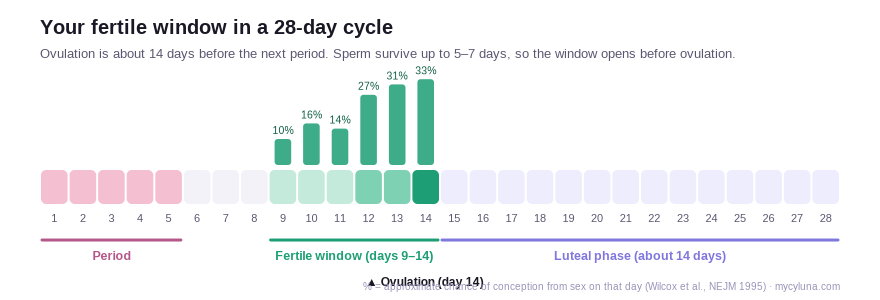
Most fertile days by cycle length
Count day 1 as the first day of full bleeding. Ovulation usually happens about 14 days before the next period, so your fertile days move with your cycle length:
| Cycle length | Likely ovulation | Most fertile days | Full fertile window |
|---|---|---|---|
| 24 days | Day 10 | Days 8–10 | Days 5–10 |
| 26 days | Day 12 | Days 10–12 | Days 7–12 |
| 28 days | Day 14 | Days 12–14 | Days 9–14 |
| 30 days | Day 16 | Days 14–16 | Days 11–16 |
| 32 days | Day 18 | Days 16–18 | Days 13–18 |
| 35 days | Day 21 | Days 19–21 | Days 16–21 |
Want the exact dates for this month? The ovulation calculator turns your last period date into a dated fertile window, and the ovulation calendar maps it six months ahead.
Signs you are at your most fertile
The calendar gives you an estimate. Your body gives you live data. The most useful signs are:
- Egg-white cervical mucus. Clear, slippery and stretchy between your fingers. It appears as oestrogen peaks just before ovulation. Read more in our egg white discharge guide.
- A positive ovulation (LH) test. The LH surge usually comes 24 to 36 hours before ovulation, so a positive test means your two best days are now. See how the LH surge works.
- Mild one-sided pelvic ache. Some people feel a twinge around ovulation, known as mittelschmerz.
- Higher sex drive. Libido often rises in the fertile window.
- A temperature rise afterwards. Basal body temperature rises slightly after ovulation, so it confirms ovulation has happened rather than warning you in advance.
For more detail, see signs of ovulation.
Why the calendar can be wrong
A study of 221 women published in the BMJ in 2000 tracked ovulation with daily hormone tests. Even among women with regular cycles, the fertile window landed on different days from month to month, and only about 30% of women had their whole fertile window between days 10 and 17, the range many apps assume.
Stress, illness, travel, a change in sleep or weight, or simply natural variation can push ovulation earlier or later. That is why a calendar works best as a starting point, and why pairing it with mucus checks or LH tests gives a much clearer picture.
Find your fertile window now
Enter the first day of your last period and your usual cycle length. Everything stays in your browser.
Ovulation CalculatorIf your cycles are irregular
If your cycle length changes by more than about 7 days from month to month, a single predicted day is less useful. Instead:
- Use your shortest and longest recent cycles to get a range: our irregular period calculator does this for you.
- Start checking cervical mucus or using LH tests a few days before the earliest possible fertile day.
- If tracking feels stressful, sex every 2 to 3 days throughout the cycle covers the fertile window without needing to pinpoint it.
Conditions such as PCOS can mean ovulation happens late, irregularly or not every cycle. Our guide to ovulation with irregular periods covers this in more depth.
When to get help
The NHS suggests seeing a GP if you have not conceived after a year of trying, or sooner if you are 36 or over, or if you know of a possible fertility problem. It is also worth booking an appointment if your periods are very irregular, very painful or have stopped.
Sources
- NHS: Periods and fertility in the menstrual cycle
- Wilcox AJ, Weinberg CR, Baird DD. Timing of sexual intercourse in relation to ovulation. NEJM 1995
- Wilcox AJ, Dunson D, Baird DD. The timing of the “fertile window” in the menstrual cycle. BMJ 2000
- ACOG: Fertility awareness-based methods of family planning
- NHS: Infertility