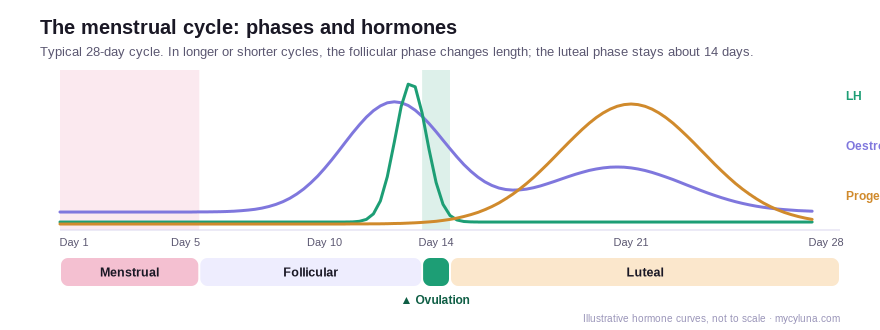
Cycle length
- The NHS gives the average cycle as about 28 days, and describes regular cycles anywhere from 21 to 35 days as normal.
- In 612,613 ovulatory cycles from 124,648 users of a cycle-tracking app, the mean cycle length was 29.3 days, and only 13% of cycles were 28 days long (Bull et al., npj Digital Medicine, 2019).
- In the same study, average cycle length got shorter with age: by about 0.18 days per year between ages 25 and 45.
- Cycle-to-cycle variation was about 0.4 days (14%) higher in women with a BMI over 35 than in women with a BMI of 18.5–25.
Phase length
- The average follicular phase (period start to ovulation) was 16.9 days, with a wide 95% range of 10 to 30 days (npj Digital Medicine, 2019).
- The average luteal phase (ovulation to next period) was 12.4 days, with a 95% range of 7 to 17 days. The NHS puts the time from egg release to the next period at around 10 to 16 days.
- Because the luteal phase is steadier, a longer or shorter cycle mostly means ovulation happened later or earlier. That is why calculators count back from the next period rather than forward from the last one.
Ovulation and the fertile window
- In 221 women planning a pregnancy, conception only happened from sex during a 6-day window ending on ovulation day. The chance per cycle rose from about 10% five days before ovulation to about 33% on ovulation day (Wilcox et al., NEJM, 1995).
- The same study found the timing of sex had no practical influence on the baby's sex.
- Only about 30% of women had their fertile window entirely within days 10 to 17 of the cycle; on every day from day 6 to day 21, women had at least a 10% chance of being in their fertile window (Wilcox et al., BMJ, 2000).
- The NHS notes that sperm can survive for up to 7 days after sex.
Implantation and early pregnancy
- In most successful pregnancies, the embryo implants 8 to 10 days after ovulation, and the risk of early pregnancy loss rises with later implantation (Wilcox et al., NEJM, 1999).
- Pregnancy tests detect hCG, which only appears after implantation, so a test is most reliable from about 14 days after ovulation. See the DPO chart.
Periods across a lifetime
- Periods usually last 2 to 7 days, with about 20 to 90 ml of blood lost (NHS).
- The average age for periods to start is around 12, and the average age of menopause in the UK is 51. Between 12 and 52, the NHS estimates a woman will have around 480 periods.
Use these figures
You are welcome to quote or chart any figure on this page. Please credit the original study and link to this page (https://mycyluna.com/cycle-length-facts/).