DPO chart, day by day
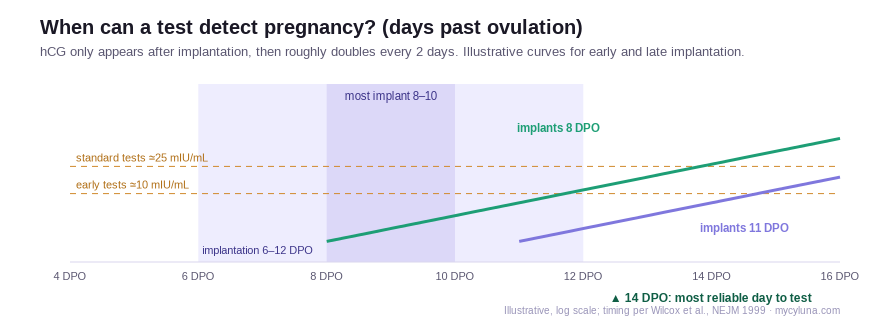
DPO means “days past ovulation”. Ovulation day is 0 DPO. Here is what is typically happening at each stage if an egg has been fertilised:
| DPO | What is happening | Pregnancy test? |
|---|---|---|
| 0 | Ovulation: the egg is released and lives about 12–24 hours | No |
| 1–2 | Fertilisation (if it happens) in the fallopian tube; cells start dividing | No |
| 3–4 | The early embryo travels down the tube towards the womb | No |
| 5–6 | It reaches the womb as a blastocyst and prepares to attach | No |
| 6–7 | Earliest implantation for some pregnancies | No |
| 8 | A common day for implantation. Read the 8 DPO guide | Almost always negative |
| 9 | Implantation continues; hCG begins entering the blood | Very early tests may rarely show a faint line |
| 10 | hCG rising for earlier implanters. Read the 10 DPO guide | Positive is real; negative is not final |
| 11 | Later implanters now attaching; hCG roughly doubles every 2 days | Positive is real; negative is not final |
| 12 | Last common day for implantation | Many pregnancies now detectable |
| 13 | hCG rising in most ongoing pregnancies | Most pregnancies detectable |
| 14 | Period is due for many people | Most reliable day to test |
Days are typical ranges, not exact. Bodies vary, and so does the length of the luteal phase.
Key Takeaways
- Implantation usually happens 6 to 12 DPO, most often 8 to 10 DPO.
- Tests detect hCG, which only appears after implantation.
- A positive test at any DPO is real; a negative before 12 to 14 DPO is not final.
- Early "symptoms" mostly come from progesterone, which rises every cycle.
How to count DPO
If you use ovulation (LH) tests, ovulation usually happens about a day after your first positive, so that next day is roughly 0 DPO. If you track basal body temperature, the day before your temperature rises is usually ovulation.
If you do not track ovulation, estimate it: ovulation is about 14 days before your next expected period. In a 28-day cycle, cycle day 14 is about 0 DPO, cycle day 21 is about 7 DPO, and cycle day 28 is about 14 DPO. The implantation calculator and pregnancy test calculator do this maths for you.
Why symptoms can’t tell you
After every ovulation, the hormone progesterone rises, whether or not you are pregnant. Progesterone causes many of the “signs” people look for in the two-week wait: sore or heavy breasts, bloating, tiredness, mood changes, cramps and changes in discharge.
That means symptoms at 3, 5 or even 9 DPO feel the same in pregnant and non-pregnant cycles. Light spotting around 8 to 12 DPO can be implantation bleeding, but many pregnant people never have it, and spotting has other causes too. See heavy implantation bleeding and implantation vs ovulation cramps for more.
Find your reliable test date
Enter your ovulation date or last period and see today's DPO and the day a test becomes reliable.
Pregnancy Test CalculatorWhen to test
- Best: 14 DPO, or the day your period is due, with first-morning urine.
- Testing early: fine if you want to, but treat a negative as “not yet” and retest 48 hours later.
- Faint line: a line within the test’s reading time counts. Retest in 48 hours; it should get darker as hCG rises.
When to get help
Get urgent helpA positive test together with pain on one side of your lower tummy, shoulder-tip pain, dizziness or fainting needs urgent medical care, as these can be signs of an ectopic pregnancy.
If you get a positive test, contact your GP or midwife to start antenatal care. If your period is more than a week late and your tests stay negative, see our guide on how late a period can be before you should worry.